

CPC: The AI Rack Cabling Revolution: From PCB Topology to Cable Backplanes
Original Article By SemiVision Research [Reading time: 12 mins]


The Open Compute Project (OCP) is bringing together APAC communities for a very special two-day, in-person Summit to explore the many challenges and opportunities facing data center infrastructure, today and tomorrow. The OCP APAC Summit will showcase the latest innovations and technical advancements from around the world, and feature talks from experts who are researching, designing, building and running the next generation of hyperscale data center facilities and infrastructure. The Expo Hall will bring together buyers and sellers from the entire ecosystem and supply chain.
https://2026ocpapac.fnvirtual.app/
The AI Rack Cabling Revolution: From PCB Topology to Cable Backplanes
In traditional server and switch designs, signal topology is typically built around the PCB. High-speed signals exit the ASIC package, enter the motherboard, traverse multiple layers of PCB routing, and finally connect to front-panel modules or backplanes through connectors. This architecture remained viable in the 56G and 112G SerDes generations, but once data rates enter the 224G PAM4 era, the signal loss in PCB routing begins to deteriorate rapidly.
This is why hyperscalers, when designing next-generation AI cluster architectures, are rethinking the entire rack-level cabling strategy. Instead of relying on traditional PCB backplanes, new designs are gradually shifting toward a cabled backplane architecture. In this approach, connections within the rack are no longer implemented through PCB routing, but rather through high-speed cables directly linking system components.
Co-Packaged Copper (CPC) plays a central role in this architecture. By integrating high-speed connectors directly onto the package substrate, CPC allows cables to extend directly from the chip package to other modules within the rack. This design not only reduces signal loss but also provides significantly greater flexibility in rack-level wiring.
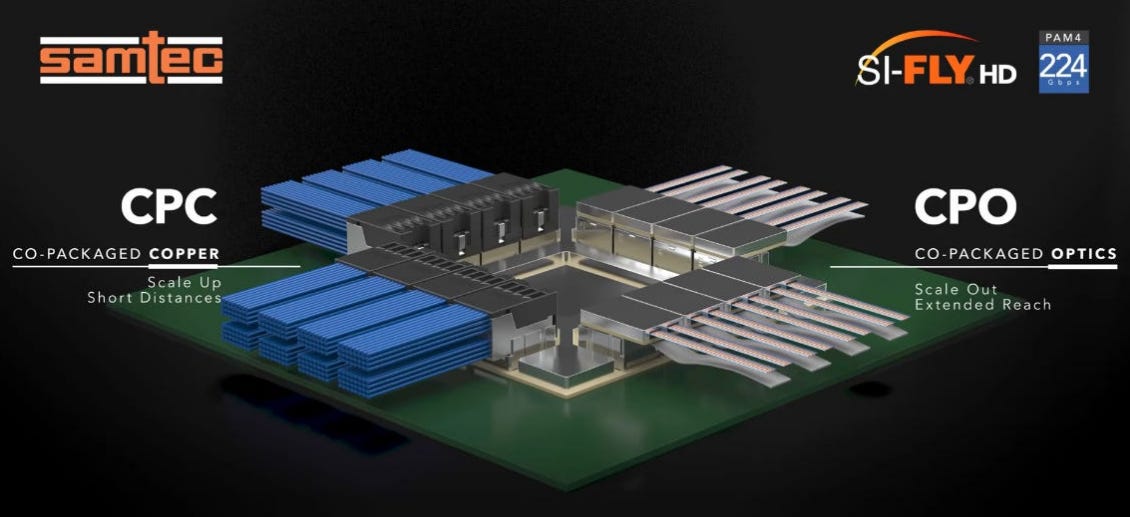
In some AI cluster design scenarios, a rack containing 72 XPUs may require over three kilometers of total copper cable length to complete its internal interconnects. If a CPC cable backplane architecture is used, the system can save tens of kilowatts of power while eliminating the latency and energy overhead introduced by retimer circuits.
This indicates that AI rack design is shifting from a “motherboard-centric” architecture to a “cable-centric” architecture. In this new model, the PCB is no longer the core of the interconnect topology—the cable network itself becomes the structural backbone of the system.

Below we will share:
Signal Integrity Advantages of CPC and Flyover Cable
The Interconnect Philosophy of Broadcom vs. NVIDIA
The Formation of the CPC Supply Chain
The Cost Battle Between CPC and Optical Interconnects
CPC and the Timeline of AI Interconnect Evolution

