

From Packets to Light Paths: OCS Reshaping AI Data Center Architecture at OFC 2026
Original Article By SemiVision Research [Reading time: 25 mins]

From Google TPU Clusters to the Optical Interconnect Era of AI Factory Networks
As generative AI and large language models (LLMs) drive compute demand to grow exponentially, traditional electrical interconnect networks are increasingly unable to support the scale and energy-efficiency requirements of next-generation AI clusters. At the 51st Optical Fiber Communication Conference (OFC 2026), AI data center optical switching—especially Optical Circuit Switching (OCS)—has emerged as a central theme, underscoring its strategic importance for AI infrastructure over the coming decade. Official OFC 2026 programming places OCS, photonic switching, and AI-cluster interconnects at the heart of its agenda, including dedicated workshops such as “Optical Networking for AI Datacenters: Technology Enablers and Key Applications” and “Photonic Switching for AI Infrastructure – Architecting the Next-Generation AI Fabric,” as well as panels on recent advances in AI cluster interconnects.
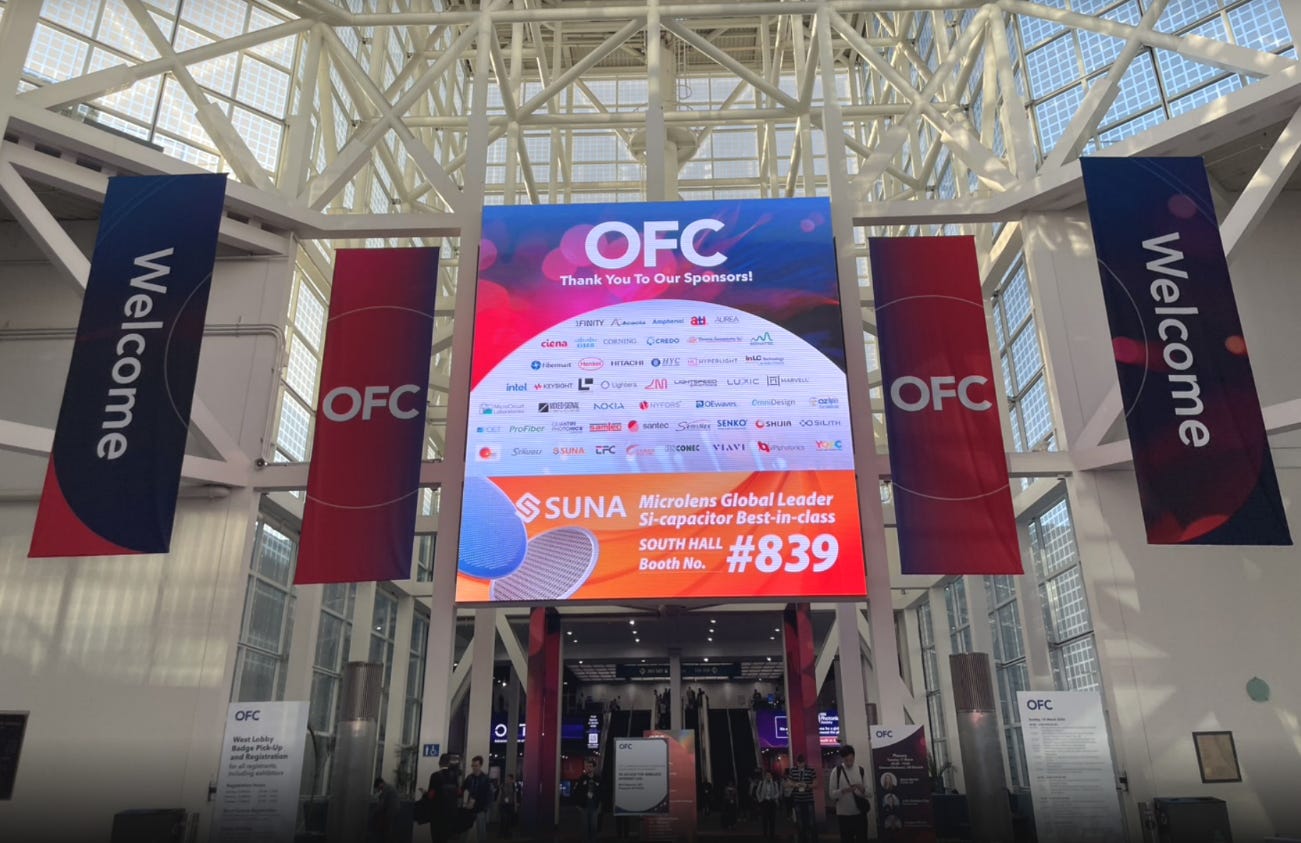
While previous-generation data centers relied primarily on packet-switched Ethernet or InfiniBand networks, these electrical fabrics are now running into hard constraints as GPU and TPU counts scale into the thousands and, increasingly, tens of thousands. The challenge is no longer only bandwidth; it is also fabric architecture, power efficiency, and system utilization. OFC 2026 explicitly frames this transition as a broader shift from conventional cloud networking toward optical technologies capable of enabling next-generation AI infrastructure. The conference’s Data Center Summit and plenary messaging both highlight hyperscale datacenter optics, AI-driven network architectures, and the urgent need for sustainable, high-capacity interconnect systems.
Semiconductor scaling and advanced 3D packaging have created unprecedented compute density, but chip-to-chip and rack-to-rack I/O bandwidth has not kept pace. This widening mismatch—often described by the industry as the I/O wall—is pushing optical interconnect ever closer to the compute and switching domains. OFC 2026’s invited and tutorial program reflects this shift directly, with talks such as “Optical Switching for AI Factories,” “Recent Advancements in Optical Circuit Switches for AI Applications,” and “Scale-Out and Scale-Up Photonic Interconnects.” Together, these sessions signal that the industry is no longer discussing optical switching as a niche research topic, but as a practical architectural lever for scaling AI systems.
Optical circuit switching offers a fundamentally different approach from electrical packet switching. By establishing reconfigurable optical paths in the optical domain, OCS can dramatically reduce the number of optical-electrical-optical (OEO) conversions, lowering latency and cutting power consumption. Unlike electronic switches, which require continuous power to inspect and process packets, optical switches consume minimal steady-state energy once a circuit is established. OFC’s official workshop description highlights these advantages explicitly, focusing on OCS use cases, performance benchmarks, orchestration strategies, and enabling technologies such as MEMS, LCoS, and silicon photonics.
This is especially relevant for AI training clusters, where communication patterns are large, repetitive, and often predictable enough to benefit from dynamically reconfigurable optical connectivity. As AI systems evolve toward “AI factories,” the network is becoming a first-order design constraint rather than a background utility. OFC 2026’s programming repeatedly uses the language of AI fabrics, AI cluster interconnects, and optical networking for AI datacenters, indicating a growing consensus that future large-scale AI systems will require a tighter integration of photonics, switching, packaging, and software orchestration.
The exhibition side of OFC 2026 reinforces that this transition is moving beyond theory into commercialization. Exhibitor announcements from companies such as DiCon, Salience Labs, and Lightelligence showcase new OCS platforms aimed squarely at AI data center applications, including MEMS-based large-port-count matrices, silicon-photonic optical switches, and distributed OCS modules embedded more directly into network architectures. These announcements point to an industry race not only around switch radix and insertion loss, but also around packaging, cost structure, and deployability in leaf-spine and AI-server connectivity topologies.
OCS is increasingly viewed as a critical candidate for the next generation of AI data center networking. It promises high bandwidth density, lower power, and a path to scaling beyond the practical limits of pure electrical switching. Based on OFC 2026’s public agenda and industry activity, the discussion is no longer whether optical switching matters, but where it will be inserted first, how it will be orchestrated with packet networks, and which device technologies will win. The following eight sections examine the architectural evolution of OCS in AI data centers, real-world deployment pathways, key enabling components, and the long-term outlook for photonic fabrics in the AI era.
We will share below,
Optical Switching in Google TPU Supercomputing Clusters
NVIDIA’s AI Factory and Optical Switching Network Architecture
Breakthroughs in Silicon Photonics and MEMS Optical Switching Technologies
PCIe-over-Optics and Composable Compute Architectures
Ultra-Large Optical Switching Matrices and AWGR Wavelength Routing Architectures
Applications of OCS in Large Language Model Training and Inference
Scalable Deployment of OCS in AI Data Centers and Expandable Network Architectures
Key Technology Trends
Conclusion: OCS as the Backbone of Future AI Networks