The New Power Stack for AI Servers: MLCCs, Silicon Capacitors, Vertical Power Delivery, and Supply Chain Shifts
Original Article By SemiVision Research [Reading time: 24 mins]

The New Power Stack for AI Servers: MLCCs, Silicon Capacitors, Vertical Power Delivery, and Supply Chain Shifts
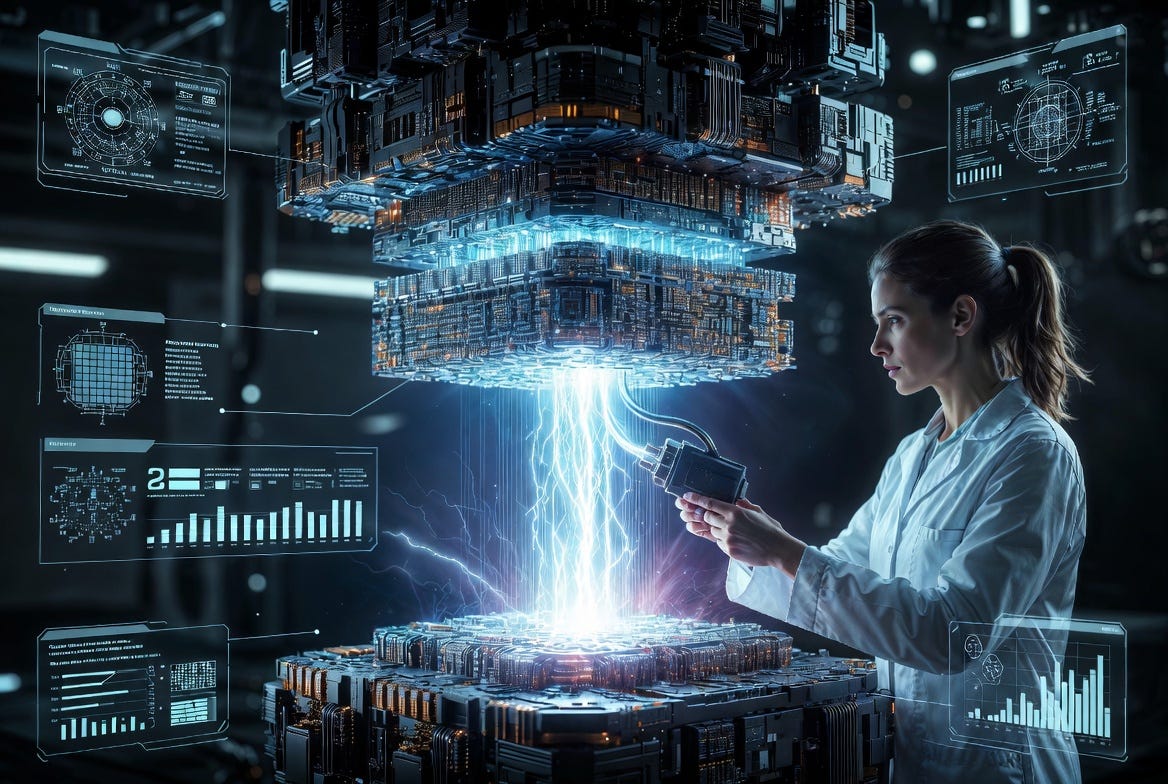
In recent years, the rapid development of artificial intelligence (AI) and high-performance computing (HPC) has driven a profound transformation in data center and server architectures. The power consumption of GPUs, TPUs, AI accelerators, and dedicated SoCs has increased sharply. The power draw of a single AI GPU has risen from several hundred watts in earlier generations to nearly one kilowatt today. Power demand for a single server rack has increased significantly from 5–15 kW to 40–60 kW, and is expected to exceed 100 kW in the future.
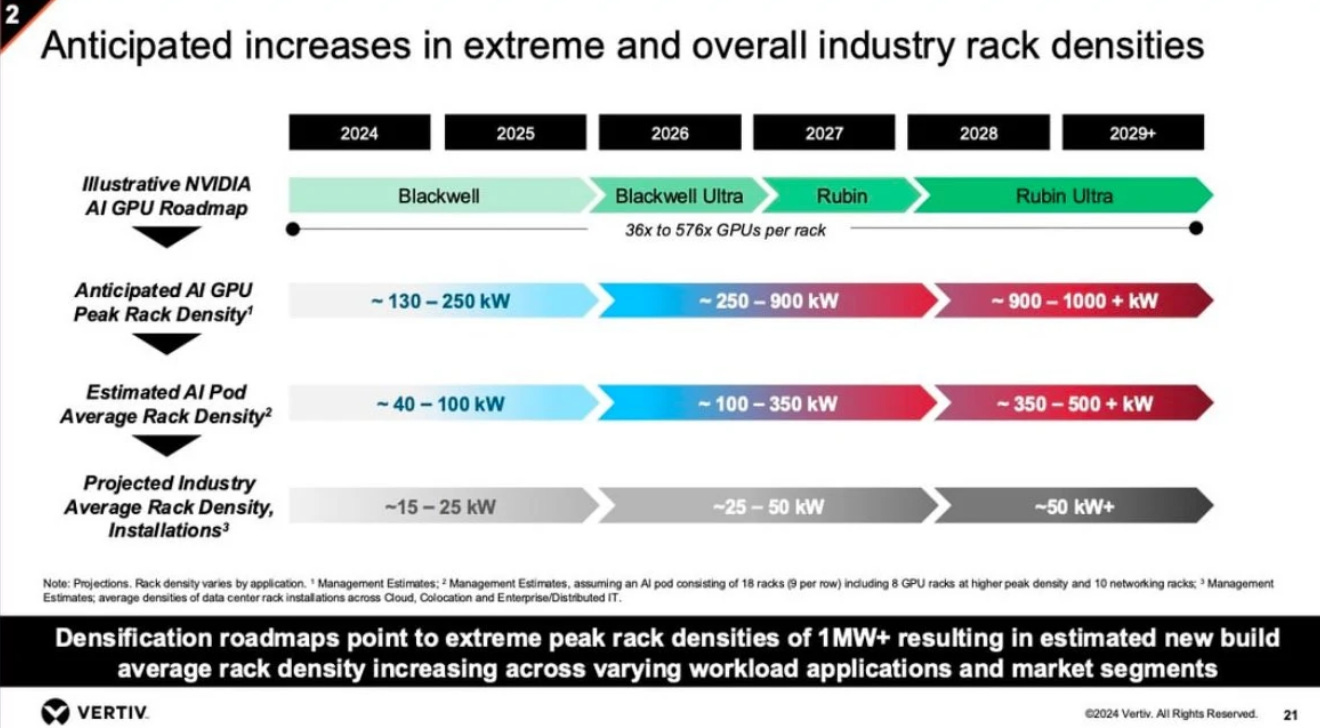
Total data center electricity consumption accounted for approximately 4% of global electricity usage in 2024 and is projected to rise to 8–12% by 2030, with AI workloads serving as a major driver.
Against this backdrop, power supply systems are facing enormous challenges:
Low-voltage, high-current operation and high-frequency transients:
AI accelerators typically operate at low voltages of 0.8–1.2 V, while instantaneous current can reach hundreds or even thousands of amperes. Voltage droop tolerance is only in the range of several tens of millivolts. Any insufficient transient response may lead to system failure or downtime.Space and thermal management constraints:
As server rack density increases, power modules must become smaller and thinner while also handling higher heat flux.Parasitic impedance in the power delivery path:
Traditional horizontal power delivery architectures, which supply power from the motherboard to the processor, involve long routing distances and PCB vertical vias. These introduce large parasitic inductance, resulting in longer current loops and making it difficult to meet high-speed transient requirements.Supply chain and cost pressures:
AI servers require 10–15 times more passive components than conventional servers, especially in ultra-high-capacitance and high-voltage MLCCs. Demand for these components has surged. Major manufacturers are shifting capacity toward high-end applications, causing shortages in general-purpose MLCC supply and driving prices higher.
To address these issues, capacitor technologies, power delivery architectures, and magnetic materials are evolving rapidly. This article provides an in-depth analysis of the characteristics and application scenarios of different capacitor types, including MLCCs, tantalum capacitors, polymer capacitors, and silicon capacitors (SiCaps). It also examines advanced power delivery architectures such as vertical power delivery, embedded trench capacitors (eTDC), and integrated voltage regulators (IVR). Finally, the article analyzes the strengths and challenges of Japan, South Korea, and Taiwan within the relevant supply chains.
Capacitor Technology Classification and Characteristics
Multilayer Ceramic Capacitors (MLCC)
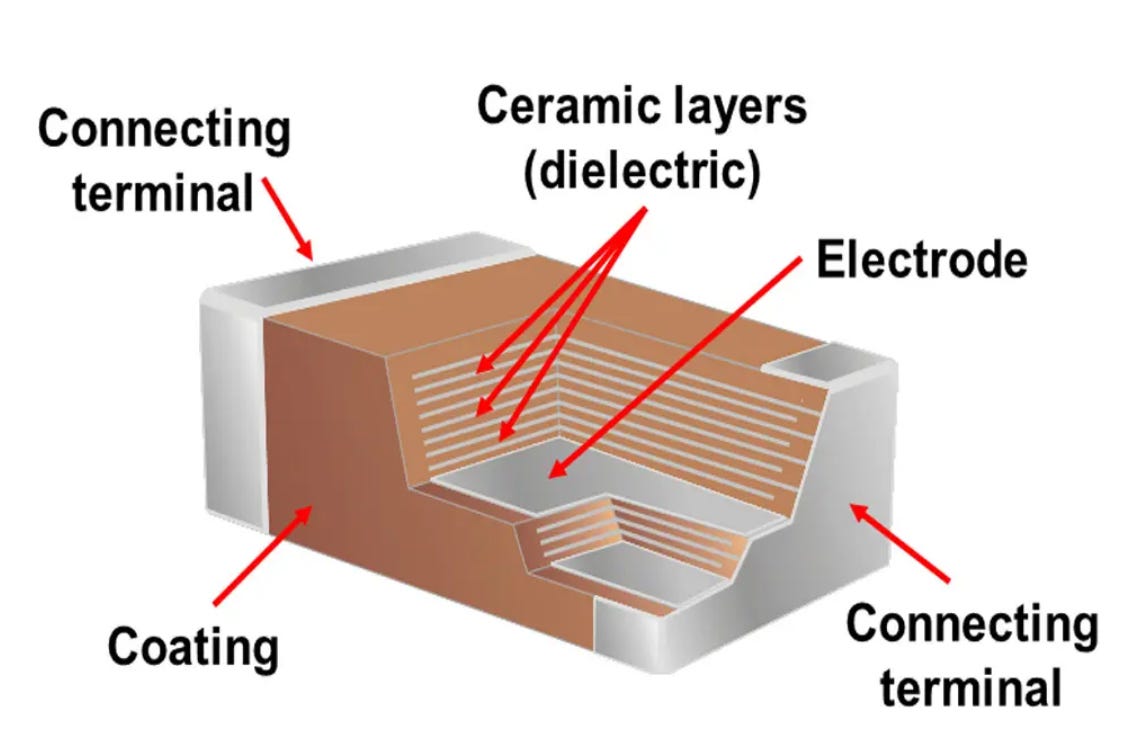
MLCCs are the most widely used decoupling and filtering components in modern electronic products. They offer advantages such as low ESR, low ESL, low cost, temperature stability, and scalability to smaller form factors. As AI/HPC servers place increasingly stringent requirements on power integrity (PI), both the applications and specifications of MLCCs have been significantly upgraded.
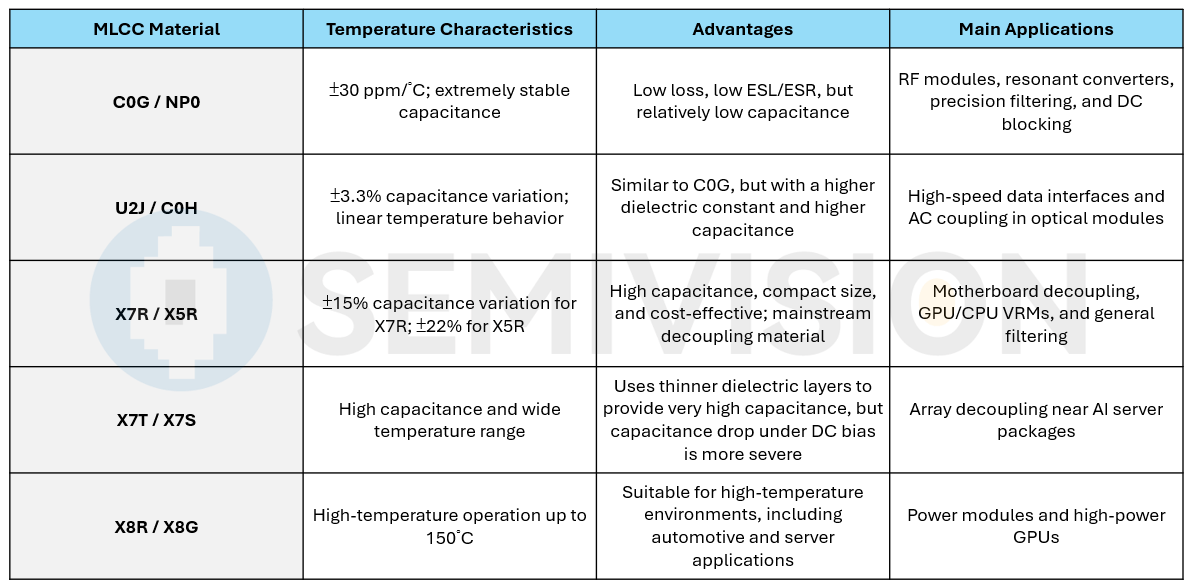
The dielectric codes are industry-standard MLCC temperature-characteristic classifications, but actual electrical performance varies significantly by manufacturer, product series, case size, rated voltage, and DC bias conditions.
In AI servers, the power consumption of a single GPU/TPU can reach 300–800 W, while the tolerance for power noise is only around ±2%. Therefore, dense arrays of low-ESL MLCCs in 0201/01005 form factors must be placed near the package. In some cases, MLCCs are even embedded inside the PCB inner layers to shorten the current loop. These MLCC arrays absorb high-frequency noise in the MHz–GHz range and suppress transient voltage droop.
However, MLCCs have several limitations:
Capacitance loss under DC bias and temperature:
As dielectric layers become thinner, capacitance becomes highly sensitive to voltage. Under rated voltage, capacitance may drop by 40–70%. In high-temperature environments of 85–125°C, the effective capacitance may decline further.Mechanical cracking and reliability issues:
High-layer-count, high-stress structures are prone to cracking, making soft-termination designs necessary.Limitations in large capacitance:
Even with high-k dielectrics, the maximum capacitance of a single MLCC is usually limited to the range of several tens of microfarads (µF). In low-voltage power paths, dozens of MLCCs often need to be connected in parallel to meet capacitance requirements from the µF to mF range.
Below we will share:
Tantalum Capacitors and Polymer Capacitors
Silicon Capacitors (SiCap)
Overview of Capacitor Application Scenarios
Vertical Power Delivery Architecture and Advanced PDN
Integration of Embedded Trench Capacitors (eTDC) and SiCap
Trend of Integrated Voltage Converters: From Board-Level Power Delivery to On-Chip IVR
Supply Chain Analysis
Market Trends and Future Outlook