

Beyond Chips: Washington Expands Semiconductor Security to Polysilicon
Original Article By SemiVision Research [Reading time: 10 mins]

Beyond Chips: Washington Expands Semiconductor Security to Polysilicon
If the defining semiconductor story of 2025 and 2026 has been AI pushing advanced logic, HBM, and advanced packaging into chronic supply tightness, Washington’s latest move suggests that the next phase of competition may begin much further upstream.
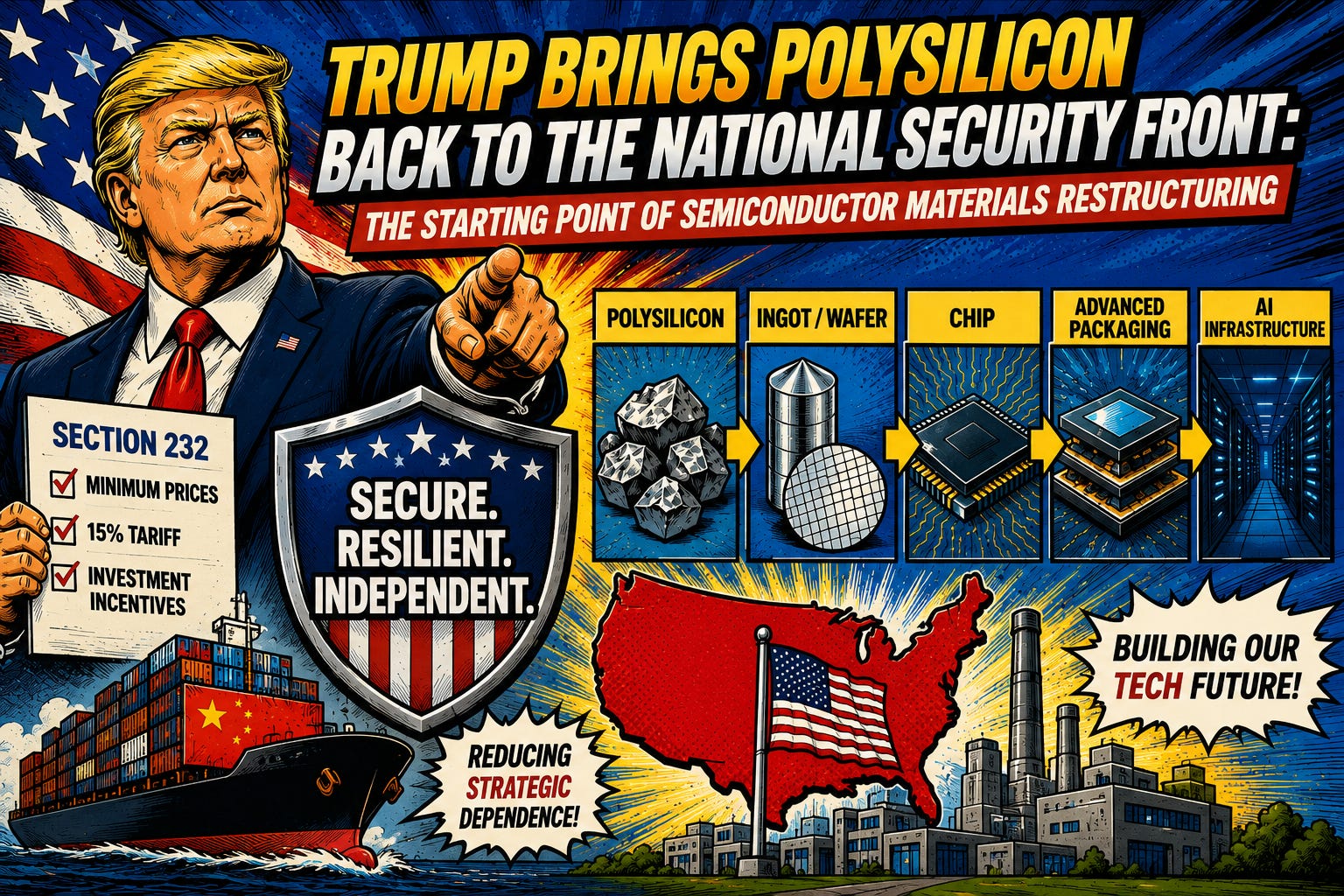
On August 6, 2026, the White House issued a new Section 232 proclamation covering polysilicon and its derivative products, explicitly framing polysilicon as a national-security input for both the semiconductor and solar industries. The measure introduces minimum import prices, additional tariffs on specified downstream derivatives, and an incentive mechanism designed to encourage companies to build or expand production capacity in the United States. Most provisions take effect on December 4, 2026, giving the supply chain roughly 120 days to adjust contracts, inventories, sourcing strategies, and investment plans.
ADJUSTING IMPORTS OF POLYSILICON AND ITS DERIVATIVES INTO THE UNITED STATES
At first glance, this looks primarily like another solar-industry trade measure.
For the semiconductor industry, however, the more important development is the policy logic behind it.
Washington is no longer treating semiconductor security as simply a question of whether enough advanced chips can be fabricated in the United States. The policy perimeter is moving upstream—from GPUs, fabs, lithography tools and packaging capacity toward the fundamental materials required to sustain those manufacturing ecosystems.
That could mark the beginning of a much broader restructuring of the semiconductor materials supply chain.
This Is More Than a Tariff
The August 6 proclamation combines three separate policy mechanisms.
First, the United States establishes minimum import prices, or MIPs, of $21/kg for polysilicon, $100/kg for polysilicon ingots and wafers, $0.22/W for solar cells, and $0.38/W for solar modules. If qualifying imports are entered below those thresholds, importers can effectively face a tariff equal to the difference between the declared value and the applicable minimum price.
Second, beginning December 4, specified polysilicon ingots and downstream derivative products will face an additional 15% Section 232 tariff, subject to country-specific arrangements. Importantly, this should not be interpreted as a blanket additional 15% tariff on every shipment of raw polysilicon.
Third—and perhaps most strategically important—the Department of Commerce is authorized to create an onshoring incentive program. Companies can submit plans to build, expand, or refurbish U.S. facilities producing polysilicon, ingots, wafers, or cells. Approved companies may receive tariff benefits on necessary imports while their U.S. capacity is being constructed. The proclamation requires qualifying projects to begin construction by January 20, 2029.
This combination matters.
A conventional tariff simply raises the cost of imports. An MIP plus tariff-offset mechanism tied to domestic investment attempts to change the economics of capital allocation itself.
Washington is effectively telling companies: importing will become more expensive, but companies willing to establish manufacturing capacity inside the United States may receive preferential treatment.
That is industrial policy, not simply trade protection.
Why Polysilicon Has Entered the Semiconductor Security Debate
The policy document explicitly describes polysilicon as the base material underpinning both America’s semiconductor and solar-power supply chains.

That wording is significant.
The White House notes that the U.S. share of global polysilicon production capacity fell from roughly 50% in 2005 to less than 2% in 2024. It also states that America’s share of global semiconductor wafer-fabrication capacity declined from 37% in 1990 to roughly 10% in 2024.
But another number buried inside the proclamation may be even more important for semiconductor investors.
According to the Commerce Department findings cited by the White House, semiconductor-grade polysilicon now represents only about 2.4% of global polysilicon production. Solar-grade material dominates industry volumes. As a result, the economics of high-purity semiconductor polysilicon cannot necessarily be separated from the much larger solar polysilicon ecosystem.
This creates an unusual industrial-policy linkage.
A country may want secure access to semiconductor-grade polysilicon, but maintaining economically viable domestic producers can also depend on having sufficient scale in lower-purity solar-grade production.
In other words, energy security and semiconductor security increasingly share the same upstream industrial base.
That helps explain why Washington is addressing solar cells, ingots, wafers, and semiconductor materials through the same policy framework.
The Semiconductor Security Perimeter Keeps Expanding
This did not begin in August.
On January 14, 2026, the White House had already acted under Section 232 following an investigation into imports of semiconductors, semiconductor manufacturing equipment, and derivative products. The administration explicitly argued that insufficient domestic semiconductor and equipment capacity created excessive dependence on foreign supply chains and represented a national-security vulnerability.
The polysilicon action extends that logic another step upstream.
The strategic question is therefore changing.
For several years, semiconductor supply-chain discussions have focused on whether the United States can manufacture enough advanced logic chips, whether CoWoS and other advanced packaging capacity can expand quickly enough, whether HBM supply can catch up with AI accelerator demand, and whether leading-edge lithography and manufacturing equipment remain accessible.
Those constraints remain critical.
But Washington is increasingly asking a more fundamental question:
What happens if the materials beneath those manufacturing processes are themselves concentrated in supply chains that policymakers consider strategically vulnerable?
Once governments start asking that question, the potential national-security perimeter becomes much larger.
It can include silicon wafers, high-purity chemicals, specialty gases, photoresists, advanced substrates, copper foil, glass fabrics, packaging materials, rare metals, power electronics materials, and potentially many other upstream inputs.
Polysilicon may therefore be less important as an isolated event than as a precedent.

AI Is Moving From a Chip Race to a System Race
The timing is particularly interesting because semiconductor technology itself is moving toward greater system-level integration.
At FMS 2026, Samsung introduced concept models for zHBM and zNAND-O and unveiled its 400-plus-layer V10 BV-NAND architecture. Samsung’s zHBM concept moves memory beyond the conventional side-by-side accelerator-and-HBM configuration toward vertical integration above the AI accelerator, illustrating how future AI architectures increasingly depend on the co-optimization of logic, memory, packaging, interconnects and thermal management.
During the same FMS week, Sandisk and SK hynix released the first technical specification for High Bandwidth Flash through the Open Compute Project. HBF is being positioned as a memory tier between HBM and SSD storage, attempting to bring much larger NAND-based capacity closer to AI processors while maintaining significantly higher bandwidth than conventional storage architectures.

These developments point in the same direction.
AI infrastructure competition is no longer about purchasing the fastest GPU in isolation.
It is becoming a competition over memory hierarchy, data movement, packaging, thermal architecture, power delivery and manufacturing scale.
The polysilicon decision adds another layer to that system competition: the geographic security of the materials used to build the system.

The Impact on Asia Will Not Be Uniform
China retains enormous scale advantages across many upstream manufacturing and materials categories. Stronger U.S. localization policies could encourage Chinese companies to deepen domestic integration while redirecting incremental capacity toward China’s internal market and other regions less exposed to U.S. trade restrictions.
The likely result is not simply reshoring.
It may be the development of increasingly parallel industrial ecosystems.
One supply chain would optimize around the United States and its preferred partners. Another would optimize around China and markets willing to remain integrated with Chinese manufacturing.
Japan and Korea occupy a different position.
Both have substantial capabilities in high-purity semiconductor materials, wafers, chemicals, equipment and specialty components. As the United States attempts to reduce exposure to strategically sensitive Chinese supply chains, Japanese and Korean suppliers could become increasingly valuable as technically qualified, non-Chinese sources.
The August proclamation itself reinforces this distinction.
For products from Japan, Korea, Taiwan, Switzerland, Liechtenstein and EU member states, the combined applicable ordinary tariff and additional Section 232 tariff is generally structured to equal 15%, rather than simply stacking an additional 15% on top of existing duties. The United Kingdom receives a separate 10% Section 232 rate.
This suggests the policy is not simply about shutting foreign suppliers out.
It is also about redesigning the hierarchy of acceptable foreign supply.
That is essentially friend-shoring embedded into tariff architecture.
Where Taiwan Fits
Taiwan’s strategic importance is unlikely to come from becoming a major commodity polysilicon producer.
Its relevance lies further downstream.
If Washington increasingly treats materials security, wafer security, semiconductor manufacturing and advanced packaging as parts of one integrated national-security framework, Taiwan’s ecosystem of silicon wafers, specialty chemicals, equipment components, substrates, advanced packaging and semiconductor testing becomes even more strategically significant.
The important question for Taiwanese companies will therefore not simply be:
Can we sell into the U.S. market?
It will increasingly become:
Can we demonstrate that our materials, production locations, upstream sources and ownership structure meet the sourcing requirements of a U.S.-aligned semiconductor supply chain?
That distinction could influence where companies build new plants, which suppliers they qualify, how customers structure long-term agreements, and even how products are priced.
Supply-chain provenance may gradually become almost as important as technical specification.
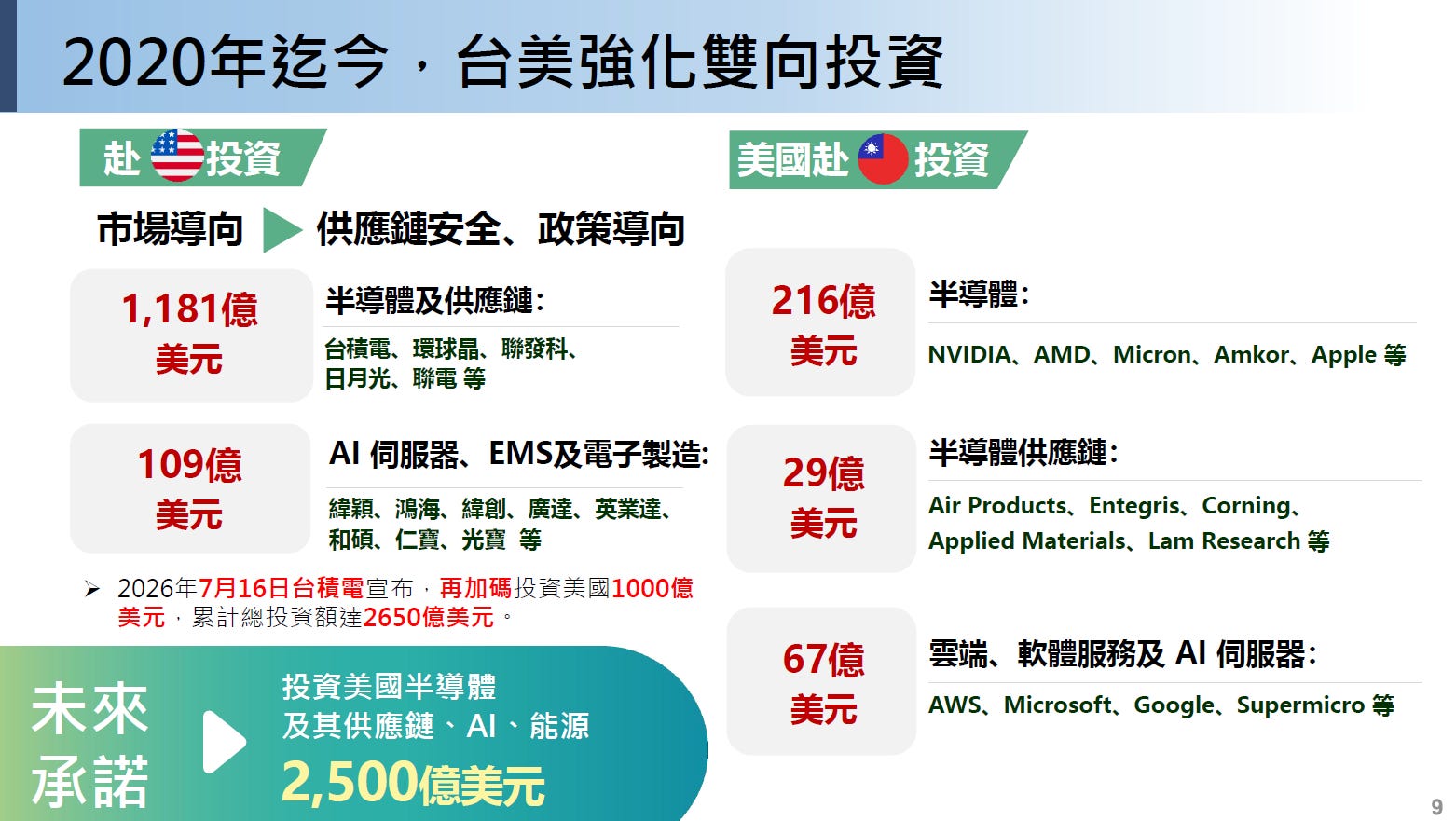
A Supply-Side Policy Arrives During a Demand Boom
The timing also increases the potential market impact.
On August 6, the Semiconductor Industry Association reported that worldwide semiconductor sales reached $403.3 billion in Q2 2026, up 35.1% from Q1. June sales reached $134.5 billion, an extraordinary 123.6% increase from June 2025 and 9.7% higher than May. SIA said global semiconductor revenue is expected to exceed $1.5 trillion in 2026.
This means the industry is not absorbing new trade restrictions during a weak demand cycle.
It is doing so while AI investment, semiconductor capital expenditure and infrastructure spending remain extremely strong.
That matters because upstream disruptions become more economically significant when downstream capacity is already tight.
Changes in material prices, lead times or approved sourcing locations can propagate through the chain into inventory accumulation, renegotiated long-term agreements, customer qualification programs and ultimately product pricing.
For investors, the issue is therefore not whether polysilicon will suddenly become a major percentage of an advanced GPU’s bill of materials.
It will not.
The issue is whether the rules governing semiconductor material sourcing are becoming structurally more restrictive.
The August 6 action suggests that they are.
What We Are Watching Next
Over the next twelve months, four indicators deserve particular attention.
First, watch which companies submit U.S. onshoring plans and whether major polysilicon, ingot or wafer suppliers announce new American capacity. The difference between policy ambition and actual industrial reconstruction will ultimately be measured in announced facilities, construction starts, customer qualifications and production volumes.
Second, watch whether Washington connects materials policy more directly with semiconductor tariffs, CHIPS-related incentives, procurement preferences and export controls. If these instruments begin operating together, the United States will be moving from individual policy actions toward an integrated semiconductor industrial-security architecture.
Third, watch for further bifurcation across Asian supply chains. Companies serving U.S. customers may increasingly qualify non-Chinese material sources, while supply chains serving China deepen domestic sourcing.
Fourth, watch procurement contracts.
If hyperscalers, semiconductor companies, OSATs and substrate manufacturers begin incorporating country of origin, material provenance or approved-source requirements into multi-year supply agreements, geopolitical alignment will have moved from government policy directly into commercial semiconductor procurement.
That would be one of the clearest signs that the industry has entered a new phase.

SemiVision View
Our view is that semiconductor competition in the second half of 2026 will increasingly be defined by something broader than the ability to design the most powerful AI chip.
The winners will be the companies—and eventually the national ecosystems—that can manufacture those chips repeatedly, at scale, using supply chains that are technologically capable, economically sustainable and politically acceptable.
That means the strategic semiconductor stack is expanding.
GPU → HBM → advanced packaging → wafers → equipment → chemicals → raw materials → power infrastructure.
Each layer is becoming part of the same AI industrial-security equation.
Polysilicon itself may never become the headline bottleneck of the AI semiconductor cycle.
But Washington’s decision to bring it formally inside the Section 232 national-security framework may be one of the earliest signals that the next semiconductor supply-chain restructuring has already begun.
