

The AI Interconnect War: Copper Fights Back Against Optics
Original Article By SemiVision Research [Reading time: 25 mins]

The AI Interconnect War: Copper Fights Back Against Optics
The In-Rack Interconnect Challenge in the AI Era
As artificial intelligence (AI) models rapidly scale in size and computational demand, data centers are evolving from traditional single-server computing architectures to massive clusters containing hundreds or even tens of thousands of GPUs working in parallel. Massive parameter counts, dense compute workloads, and high-speed data streaming have turned short-reach in-rack connectivity into one of the key bottlenecks affecting overall system performance.
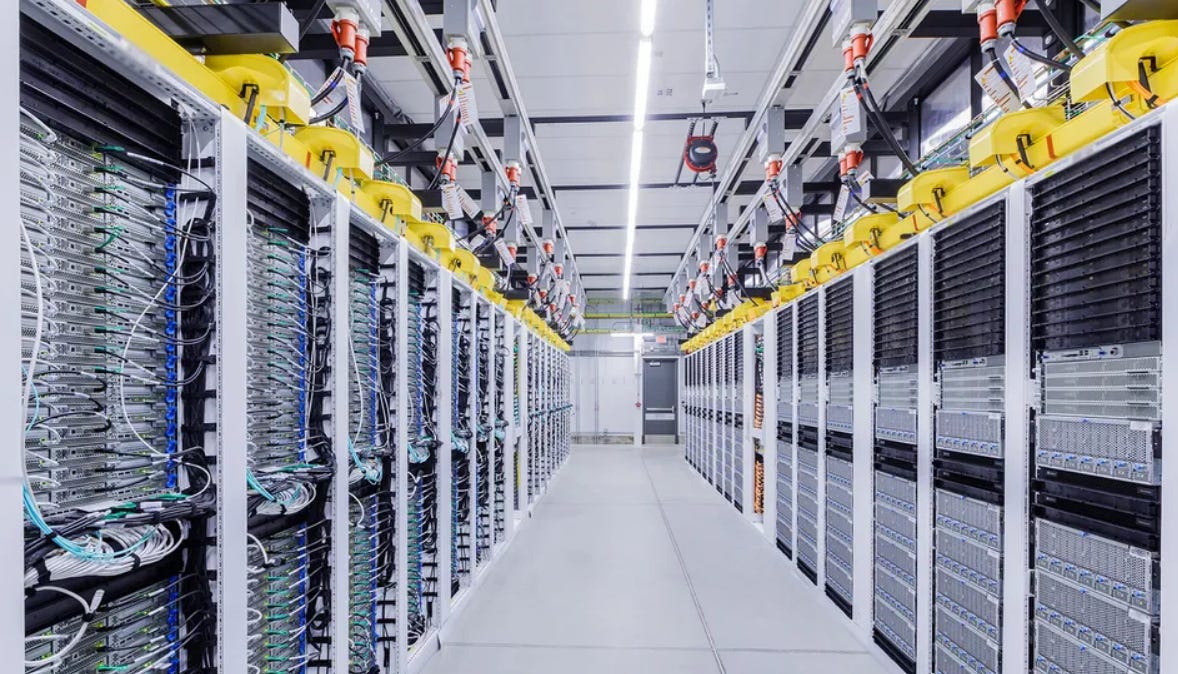
Early adopters of large-scale AI clusters have discovered that simply adding more compute power is no longer sufficient to improve system performance. Instead, factors such as bandwidth density, latency, power consumption, and link reliability increasingly determine the efficiency of AI training and inference. As a result, a critical challenge in next-generation data center architecture is how to deliver high-speed, stable, low-power, and scalable interconnect links over short distances within the rack.
Traditional data center interconnect technologies mainly include:
Printed Circuit Board (PCB) traces – Used to connect chips within a single board or module, typically spanning only a few centimeters. Signal integrity can be maintained through high-frequency PCB materials and careful routing design.
Direct Attach Copper (DAC) – Composed of copper conductors with foam insulation and no signal-processing chips. Suitable for low-speed transmission within about 1 meter. DAC was the dominant solution in Ethernet generations prior to 400G, but in the 224G/800G era its reach is limited to around 1 meter or even shorter.
Active Copper Cable (ACC) – Integrates analog equalizers (linear EQ) at both ends of the cable to compensate for signal loss. It supports short-reach links of about 2–2.5 meters and consumes very little power (around 2.5 W for 1.6T ACC). However, its equalization capability is limited and cannot perform complex signal compensation like digital processors.
Active Electrical Cable (AEC) – Embeds digital signal processors (DSPs) or retimer chips at both ends of the cable. These components compensate for insertion loss, crosstalk, and reflection loss, enabling higher data rates and longer transmission distances. AEC has become one of the most widely used short-reach interconnect technologies in 400G and 800G server racks.
Active Optical Cable (AOC) – Replaces copper cables with optical fibers and integrates optical transceivers at both ends. AOC can provide high bandwidth over 5–30 meters, but its cost and power consumption are higher, making it less suitable for very short in-rack connections.
Co-Packaged Optics (CPO) – An advanced optical interconnect approach that integrates optical engines with switching ASICs on the same substrate. It offers extremely low energy per bit and very high bandwidth, but the technology is currently complex and expensive, and the industry generally expects large-scale deployment after 2027–2029.
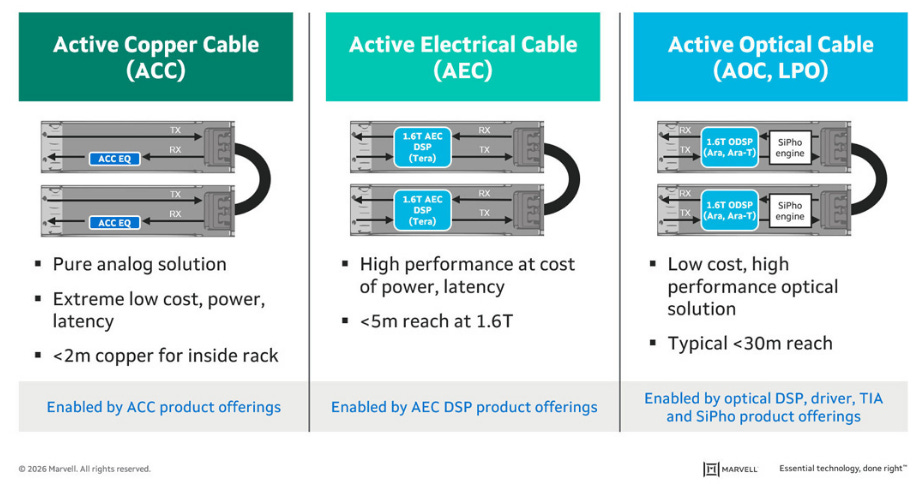
Among these options, Active Electrical Cable (AEC) has emerged as the optimal solution for short-reach in-rack interconnects in AI data centers, because it achieves the best balance between cost, power consumption, and transmission distance.
This article examines AEC technology in depth from multiple perspectives, including technical principles, industry landscape, key players, application scenarios, development trends, and challenges, providing a comprehensive view of its advantages and future evolution.
Below we will share:
Technical Principles and Architecture of AEC
Differences Between AEC and Other Cable Solutions
Power Consumption and Reach of AEC
AI and Data Center Demand for Short-Reach Interconnects
Implications of Rubin’s Cable-Free Server and Midplane Design
The 800G/1.6T Era: Physical Limits of DAC vs. AEC
Implications of Rubin’s Cable-Free Server and Midplane Design
Power Consumption and Reliability: Key Factors Driving AEC Adoption
CPO and ALC: Exploring Next-Generation Optical Interconnects
Key Suppliers and Industry Ecosystem
Cable and Connector Manufacturers
Comparison of Different Interconnect Technologies
Industry Strategy and Investment Perspective


