


When Time Stops Being Money: How AI Could Rewrite the Economics of Work
For two centuries, one of capitalism’s most durable bargains has been remarkably simple: people sell their time, and employers pay them for it. Artificial intelligence may be about to complicate that arrangement.
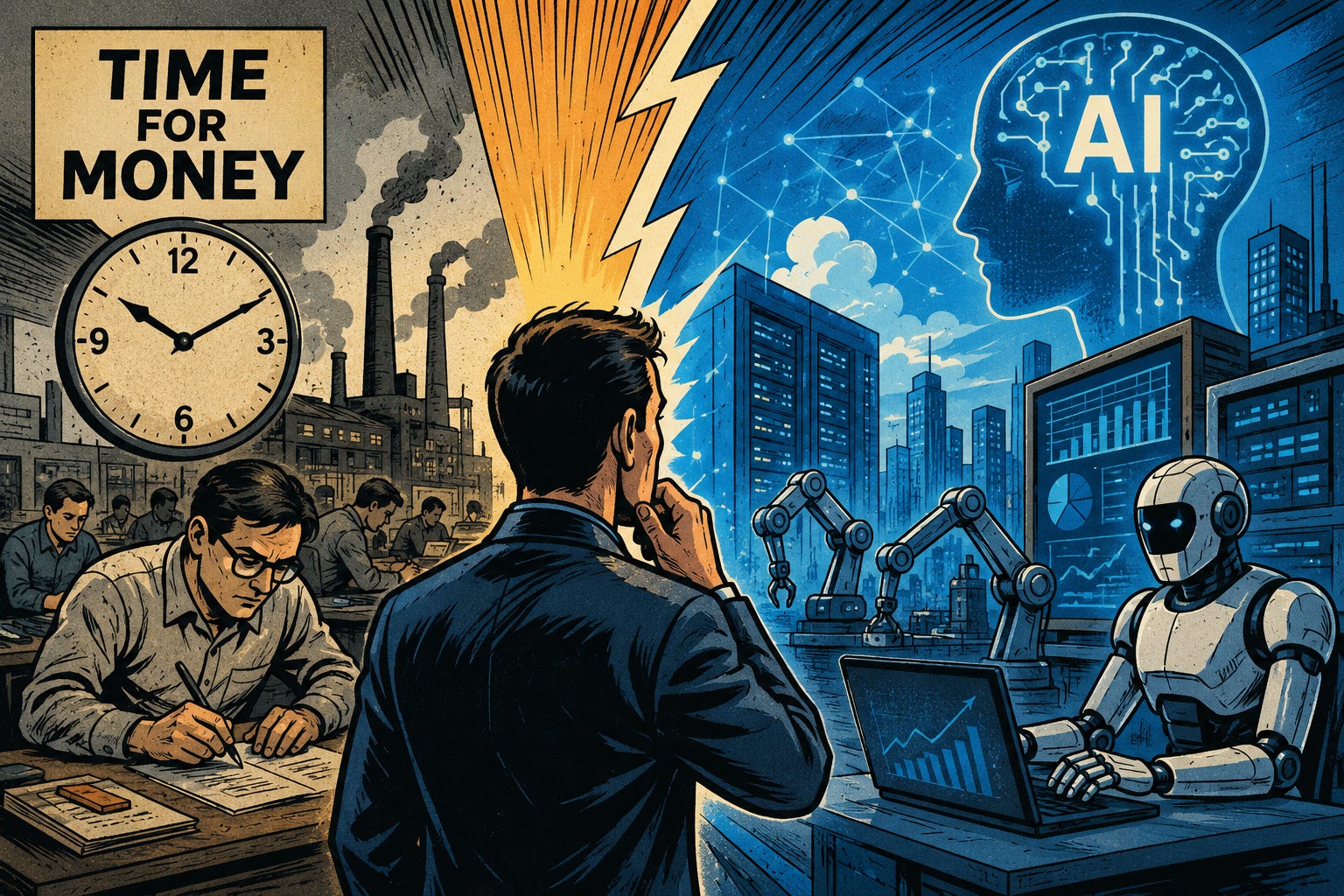
Elon Musk recently offered an especially dramatic version of this argument. Within a few years, he suggested, the idea of earning a living by selling one’s labour could begin to lose relevance as artificial intelligence assumes an ever larger share of economically useful tasks. Eventually, paying someone merely for his time may make little sense.
The timetable is almost certainly too aggressive. The direction is harder to dismiss.
The important question is not whether AI will “take all the jobs”. Technological revolutions rarely proceed so neatly. It is whether human time will remain the principal unit by which companies measure and purchase knowledge work.
For much of modern economic history, it has been. Factory workers sell shifts; consultants bill hours; lawyers record them in six-minute increments. Engineers and analysts may earn vastly more than assembly-line workers, but the underlying transaction is similar. Their expertise is bundled with a scarce resource: their time.
There are only so many hours in a day. That scarcity gives skilled labour much of its economic value.
AI begins to loosen the constraint.
The infinitely replicable colleague
Consider an engineer capable of completing one complicated analysis per day. In a conventional organisation, producing 100 such analyses requires more engineers, more time or both.
AI agents operate according to a different logic. Software can, at least in principle, be copied almost without limit and deployed simultaneously. Ten agents can search ten databases while another writes code, another tests it and yet another prepares a report. The human increasingly becomes the supervisor rather than the sole producer.
The old production function might be caricatured as:
Output = Humans × Time
The emerging one looks more like:
Output = Humans × AI × Compute × Capital
That distinction matters. Human time is stubbornly finite. Compute is expensive, but expandable. AI inference can be purchased by the token; additional agents can be spun up in seconds. As their capabilities improve and costs fall, companies will have less reason to care how many hours an employee works and more reason to care how much useful output he can orchestrate.
The scarce resource shifts from labour time towards judgment.

Not man versus machine
This also suggests that the familiar debate about “humans versus AI” is somewhat misplaced.
For many occupations, the more immediate contest will be between humans who use AI effectively and humans who do not.
Imagine two financial analysts, each working eight hours. One reads documents, constructs spreadsheets and searches databases largely by hand. The other directs a collection of AI agents to screen hundreds of filings, compare historical results, examine transcripts, build preliminary models and identify anomalies. She then spends her own time deciding which conclusions actually matter.
Both have worked eight hours. Their output may differ by an order of magnitude.
This is why the AI revolution could undermine the economic significance of the working hour long before it eliminates employment itself.
A useful measure for the next generation of companies may therefore be something like an AI leverage ratio: how much machine intelligence, compute and automated workflow can each human employee command?
Today investors obsess over revenue per employee. Tomorrow they may also care about agents per employee, compute per employee and output per human hour.
The most productive AI-native firm may not employ 10,000 people. It might employ 1,000 unusually capable people equipped with the digital equivalent of an enormous invisible workforce.
Capital strikes back
This has uncomfortable implications for the balance between labour and capital.
Industrial machinery amplified human muscle. Computers amplified calculation and communication. AI is beginning to amplify—and in some cases substitute for—cognitive labour. Robotics may eventually extend the same economics into the physical world.
The productive assets of an AI economy will therefore increasingly consist of compute, energy, models, data, robots and capital.
Ownership matters.
If a worker’s productivity comes mainly from skills embedded in his brain, he has some bargaining power because those skills cannot easily be separated from him. But if much of that productivity migrates into a model running in a data centre, the economics change.
The person who owns the model, GPU cluster, proprietary dataset or robotic fleet may capture a larger share of the surplus.
The defining economic question of the AI era could thus gradually shift from “Who has the best job?” to “Who owns the productive intelligence?”
That is a much more consequential question than whether ChatGPT can write an email.
The missing consumer
There is also an awkward macroeconomic problem hidden inside visions of near-total automation.
Suppose AI and robots eventually become capable of producing an enormous quantity of goods and services with relatively little human labour. Corporate productivity would soar. Costs might collapse.
But who buys all the output?
Modern consumer capitalism contains a convenient circularity. Companies pay wages; households spend those wages; that spending becomes corporate revenue. Labour is therefore both a cost of production and an important source of demand.
If automation sharply reduces labour’s share of national income while the ownership of productive assets remains concentrated, the system may become extraordinarily good at producing things while becoming worse at distributing the purchasing power required to consume them.
At that point, the AI debate ceases to be merely about productivity. It becomes a debate about distribution.
Governments might respond through taxes, transfers, broader capital ownership, shorter working weeks or schemes resembling universal basic income. None is economically or politically straightforward. But an economy in which machines perform much of the work would eventually require some mechanism for distributing the abundance those machines create.
Not in three years
There are good reasons to be sceptical of Musk’s timetable.
The ability to perform a task in a demonstration is not the same as the ability to replace a worker inside an organisation. Companies must contend with regulation, liability, security, hallucinations, legacy systems, customer preferences and institutional inertia.
Tacit knowledge matters too.
This is particularly obvious in manufacturing and semiconductors. Much of what an experienced process engineer knows is not contained in a manual. A technician may hear that a machine sounds wrong. A supply-chain manager may know that a supplier claiming its qualification is “on schedule” is actually struggling with yield. A materials engineer may recognise that a parameter technically within specification will nevertheless cause trouble in mass production.
Such knowledge is difficult to scrape from the internet.
The near-term equation is therefore unlikely to be:
AI + robots = no humans
It is more plausibly:
Fewer humans × much more machine intelligence = much greater output
That is disruptive enough.

The end of the hourly economy?
“Time is money” is usually attributed to Benjamin Franklin. For much of the industrial era it was excellent economic advice.
AI may make it less true.
Human time will not become worthless. Indeed, some kinds of human time—those involving exceptional judgment, trust, creativity, relationships and responsibility—may become considerably more valuable.
What could lose value is undifferentiated human time: the assumption that an hour of professional labour must be purchased because an hour of human cognition is required to produce an hour’s worth of output.
Machines are beginning to break that relationship.
The most valuable workers of the AI age may therefore not be those willing to work the longest hours. They will be those who combine domain expertise, judgment, proprietary knowledge and networks with the ability to command increasingly large quantities of machine intelligence.
For 200 years, workers have largely been paid for what they can accomplish with their own brains and hands during a finite working day.
The next economic era may reward something different: how much intelligence, capital and automation a single human can direct.
Musk may be wrong about the three years. But he may be pointing towards a much bigger change. AI does not need to abolish work to transform capitalism. It merely needs to sever the old connection between time worked and value created.
